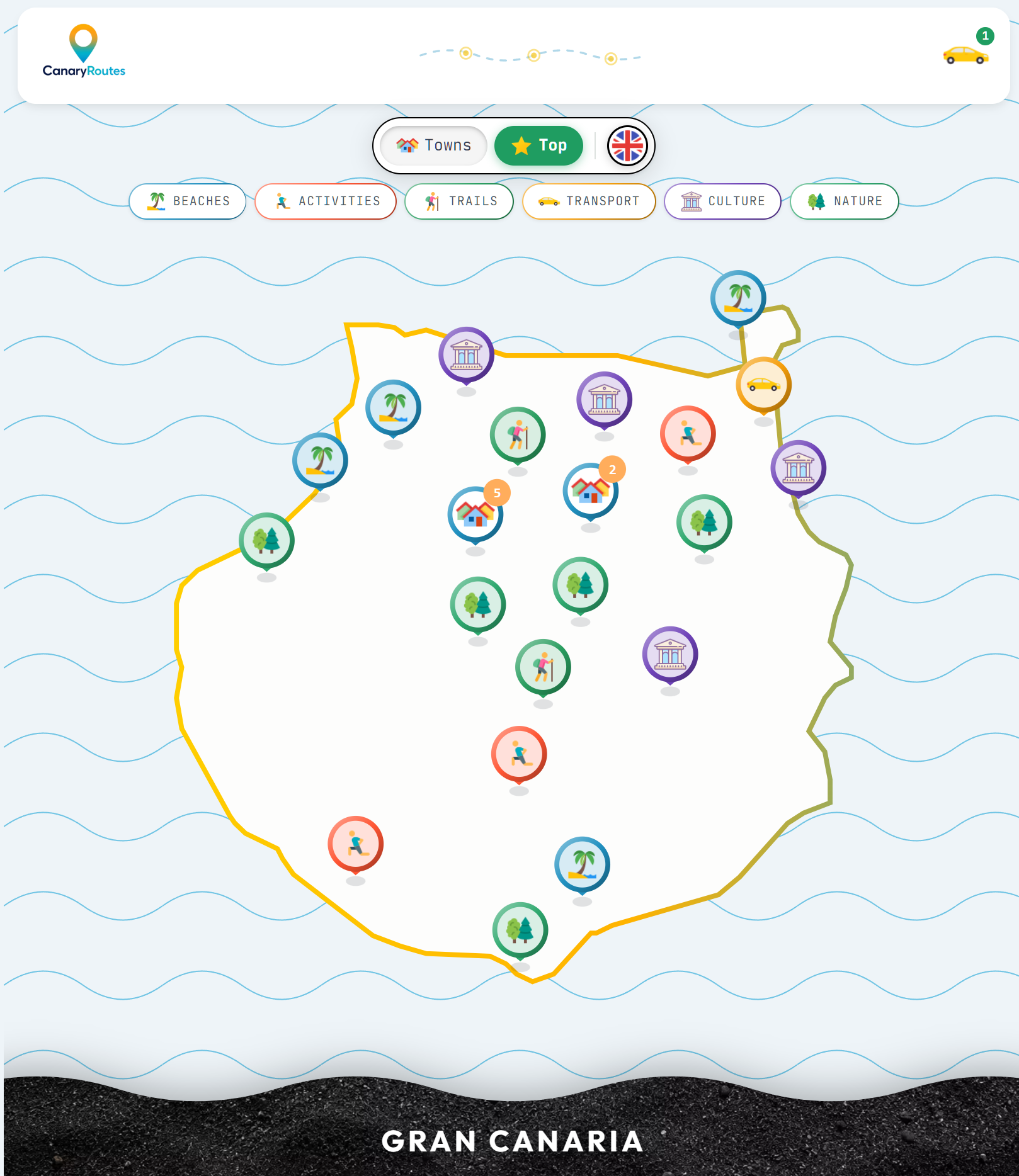
Gran Canaria has one of the most varied coastlines in the entire Canary archipelago. In just 236 kilometres of shoreline you'll find golden-sand urban beaches perfect for family swimming, wild coves accessible only on foot or by boat, volcanic rock natural pools and dunes declared a Nature Reserve. This guide covers the 10 best beaches in Gran Canaria for every type of traveller — from those seeking comfort and services to adventurers who prefer total solitude.
Spain's best urban beach: 3.2 km of fine sand in the heart of the capital with waters sheltered by La Barra, a natural reef that makes swimming a unique experience.
Playa de Las Canteras is Gran Canaria's great surprise for first-time visitors. That the island's capital has a three-kilometre fine-sand beach with calm waters all year round is a privilege unmatched by any other Spanish city. The secret lies in La Barra: a basalt reef running parallel to the shore that breaks the Atlantic swell before it reaches the beach, creating a natural lagoon of quiet, pleasantly warm water.
The seafront promenade bordering Las Canteras concentrates the best of Las Palmas' gastronomy and leisure. At the northern end, La Cicer has the best waves for surfers and bodyboarders. The central section is ideal for families. The southern zone, in front of the old Hotel Santa Catalina, is the quietest and most frequented by local bathers. La Barra reef, 50-100 metres offshore, is one of Gran Canaria's best snorkelling spots: octopuses, moray eels, parrotfish and corals at just 2-4 metres depth.
💡Practical tips
Snorkelling at La Barra is spectacular — bring fins and a mask, visibility is usually excellent.
The most authentic restaurants are on the streets perpendicular to the promenade, not on the beachfront.
The beach is lit and lively into the evening — the promenade is safe and pleasant for a sunset walk.
Park at the port or Santa Catalina car parks — parking on the seafront itself is very difficult.
The wildest southern beach: kilometres of golden sand bordering the dunes, with the Maspalomas Lighthouse in the distance and a naturist zone in the most remote section.
Playa de Maspalomas is the longest beach in southern Gran Canaria and the one offering the most spectacular landscape: its western end merges directly with the dunes, creating a sand-to-desert transition that exists nowhere else on the island. Unlike Playa del Inglés with its many services, Maspalomas retains a wilder character, especially in the kilometres bordering the dune nature reserve.
The Maspalomas Lighthouse (1890), one of the oldest in the Canaries, marks the southernmost point of the island and is the visual landmark of the entire beach. The zone near the lighthouse and the coastal lagoon (the Maspalomas charco) is prime birdwatching territory for migratory species and an exceptional photographic spot. The naturist zone is well established in the central section of the beach and is respected by all users.
💡Practical tips
To see the dunes at their best light, walk east from the lighthouse at sunrise — golden dunes and almost nobody around.
The Maspalomas lagoon is a protected wetland — don't enter it or leave rubbish nearby.
Sun loungers and parasols are available in the services area, but at the western dune end there is nothing — bring everything you need.
The water has more swell than Playa del Inglés — keep an eye on young children.
The most perfect beach in the southwest: imported white sand, turquoise sheltered waters and a horseshoe shape that makes it a permanent postcard scene.
Playa de Amadores is the most photographed beach in southwestern Gran Canaria and one of the most beautiful on the whole island. Its concave shape and very fine white sand (imported in the 1980s) create a natural pool environment where the water always appears turquoise and the swell is practically non-existent. The contrast between white sand, turquoise-blue water and the arid hillsides dropping down to the beach gives a Mediterranean aesthetic that surprises visitors in the Atlantic.
Amadores is well-equipped: sun loungers, beach bars, showers, toilets and lifeguards throughout the day in peak season. The promenade around it has restaurants and bars with good views. Arguineguín beach, 15 minutes by car, is the more authentic alternative frequented by locals if you want something less touristy.
💡Practical tips
Arrive before 10:00 am to find parking — the car park has limited capacity and fills quickly in summer.
The water is incredibly calm — perfect for young children and basic snorkelling.
The terrace of the Radisson hotel overlooking the beach offers one of the best views of the whole cove.
The cove north of the main beach has fewer services but more tranquillity.
Puerto de Mogán and its beach form the most picturesque corner of the south: bougainvilleas over the harbour bridges, fishing boats and crystal-clear water perfect for snorkelling.
Puerto de Mogán is known as the 'Venetian village of the Canaries' for its canals, flower-draped bridges and authentic atmosphere that contrasts sharply with the mass tourism of the Maspalomas-Puerto Rico corridor. The beach, small and sheltered inside the harbour, has very clear and calm water, perfect for snorkelling among the moored boats and volcanic rock on the seabed.
Beyond the beach itself, Mogán is a complete destination. The harbour market (on Fridays) draws visitors from all along the south coast. Restaurants on the promenade serve fresh fish at reasonable prices for a tourist area. And from the harbour, boat excursions head to the deserted coves of the west coast — Veneguera, Tasarte, Tasartico — which are inaccessible by road.
💡Practical tips
The Friday market starts at 9:00 am — arrive early for the best craft and local produce stalls.
Boat excursions from the harbour reach wild coves unreachable by land — essential if you have time.
Snorkelling under the harbour boats and along the rocky ends of the beach is surprisingly good.
Park in the village (not the harbour) and walk down to save time and money.
Gran Canaria's wildest beach: only accessible on foot via a 3-4 hour hiking trail or by boat, with dark volcanic sand and total isolation.
Playa de Güigüi is the most remote and spectacular beach in Gran Canaria, and probably one of the most impressive in the entire archipelago. There are two ways to reach it: a 3-4 hour trail from La Aldea de San Nicolás crossing ravines and arid hillsides with Atlantic views, or a boat excursion from Puerto de Mogán. There is no road, no services, no lifeguards — just a beach of dark sand and pebbles, surrounded by black basalt cliffs and the open Atlantic.
This difficulty of access is precisely what makes Güigüi a special destination. Daily visitor numbers rarely exceed a few dozen even at peak season. The water has swell and is not always safe for swimming, but the experience of being on a completely untouched beach in the Canary Islands is priceless.
💡Practical tips
The trail from La Aldea takes 3-4 hours each way — start before 7:00 am to arrive with good light and bearable heat.
Bring everything you need: water for the full day, food, sun protection and basic first aid — there is nothing there.
The boat from Puerto de Mogán takes 1.5-2 hours and gives you more time on the beach — ideal if you want to avoid the hike.
The swell can be strong — assess conditions before entering the water.
The most elegant southern beach: dark volcanic sand, calm waters and the Meloneras promenade lined with Gran Canaria's finest luxury hotels.
Playa de Meloneras combines what few beaches manage: a natural setting of dark sand and volcanic rock that gives it an authentic Canarian character, with the infrastructure and services of one of the island's highest-quality resort complexes. The Meloneras seafront promenade, with its shops, restaurants and five-star hotels, is the most well-maintained in southern Gran Canaria.
The water at Meloneras is noticeably calmer than at Playa del Inglés or Maspalomas, thanks to the coastline's orientation. The dark sand (basalt), unusual in the south coast where light sand dominates, gives a more authentic and distinctive aesthetic. The eastern end connects with the natural pools of La Charca, a volcanic rock environment that at low tide creates natural rock pools perfect for children.
💡Practical tips
The Meloneras promenade at dusk is one of Gran Canaria's best — lit, safe and with a good atmosphere.
The natural pools near La Charca (eastern end) are perfect for children at low tide.
Promenade restaurants have five-star hotel prices — the best value is found one street back from the beachfront.
Free parking is 5-10 minutes' walk from the promenade — don't attempt to park on the front.
Caribbean white sand in the Atlantic: the semi-private Anfi resort beach with intense turquoise water sheltered by islets and breakwaters.
Anfi del Mar is technically a semi-private access beach — it belongs to the resort complex of the same name — but it is open to the public by paying for sun lounger hire or purchasing from the bar. The sand is imported Caribbean quartz, which combined with the artificial breakwater and small islets gives the water an intense turquoise colour that looks more like the Mediterranean or Caribbean than the Atlantic.
Anfi is especially popular with southern Gran Canaria visitors wanting a premium beach experience without travelling far. The facilities are first-rate. Snorkelling around the artificial islets has good visibility. And the overall setting — with palm trees, wooden boardwalks and beach bars — creates a tropical resort atmosphere that families particularly enjoy.
💡Practical tips
Public access requires consuming at the bars or hiring a sun lounger — prices are higher than at public beaches.
Snorkelling around the artificial islets is very rewarding — bring your own equipment to avoid rental costs.
There is a boat service from Puerto de Mogán to Anfi — avoids the parking problem entirely.
Sunset at Anfi is particularly beautiful due to the west-facing orientation of the beach.
Gran Canaria's most famous natural pools: volcanic rock basins at Puerto de Las Nieves filled with Atlantic water, with Tenerife's Teide on the horizon.
The Agaete natural pools are the perfect antidote to the south's artificial beaches. At Puerto de Las Nieves on the island's far northwest, the Atlantic Ocean fills and drains natural basins carved into black basalt rock, creating a unique bathing environment. The visual contrast between black rock, turquoise water and the Anaga mountains in the distance — with Mount Teide on the horizon on clear days — is one of northern Gran Canaria's most iconic images.
The complex has changing rooms, showers and paid sun lounger access, but the pools themselves are free to use. The restaurants next to the pools serve the freshest fish on the entire northwest coast — grilled grouper, sea bream and vieja (parrotfish) are the specialities to order. In August the pools host the Fiestas del Charco, where locals try to catch fish by hand — one of the islands' most original traditions.
💡Practical tips
Pool access is free, though there are paid services (sun loungers, showers) — bring your own towels and snacks.
Combine the pools with the Valle de Agaete (Canarian coffee, chirimoyas) for a complete northwest day.
The water can be cold even in summer — the first few minutes of immersion are the hardest.
Parking at Puerto de Las Nieves can be tricky in summer — arrive before 10:00 am.
One of the most remote beaches in the southwest: reachable only via a dirt track or by boat, with dark sand, no services and exceptional water clarity.
Playa de Veneguera is the first great secret of Gran Canaria's southwest coast for those who venture beyond the tourist circuit. Hidden at the end of the deep ravine of the same name, it is reached via a dirt track off the GC-200 road (manageable for normal cars with care) or by boat from Puerto de Mogán. The beach itself is narrow, with dark sand and volcanic shingle, flanked by basalt cliffs and surrounded by completely wild ravine vegetation.
Veneguera's water is exceptionally clean and transparent, with a sand and rock bottom clearly visible even at 3-4 metres. In low season the visitor count is minimal — you can have the beach virtually to yourself. Spearfishing and snorkelling are among the best on the south coast, with a marine biodiversity that the packed southern beaches can never match.
💡Practical tips
The track from the GC-200 is 8 km of dirt — manageable in a standard-height car but go slowly.
There are no services at the beach — bring water, food and everything you need for the day.
The boat from Puerto de Mogán is the most comfortable option if you don't want to drive the track.
Underwater fishing here is exceptional — bring diving equipment if you're into it.
The most authentic northern beach: a small fishing village with dark sand, unpretentious fish restaurants and the most genuinely Canarian atmosphere on the coast.
Playa de Sardina del Norte, in the municipality of Gáldar, is exactly the kind of beach that mass tourism hasn't discovered yet. The small fishing village surrounding it retains the essence of northern Gran Canaria's coastal villages: fishing boats on the shore, nets drying in the sun, a whitewashed chapel on the headland and restaurants where the fish served at lunch left the sea that same morning.
The beach itself is narrow, with dark volcanic sand and shingle, and the northern water is colder and choppier than the south. But the experience of eating grilled grouper with sea views in one of the village beach bars, with the Sardina lighthouse in the background and almost no tourists in sight, is one of the most authentic you can have in Gran Canaria.
💡Practical tips
The village restaurants serve the best fresh fish in the north — ask what came in that morning, not what's on the menu.
The Sardina lighthouse, 15 minutes' walk from the village, has spectacular views of the north coast and ocean.
The northern water is colder and choppier than the south — not ideal for family swimming with small children.
Combine with Gáldar's Cueva Pintada (15 minutes by car) for a complete northwest morning.
Which is the best beach in Gran Canaria for families with children?Which is the best beach in Gran Canaria for families with children?
For families with young children, the best options are Las Canteras (sheltered by La Barra reef, right in the capital), Playa de Amadores (very calm water and fine white sand in the southwest) and Playa del Inglés (wide range of services and calm water). For older children who enjoy snorkelling, Las Canteras at La Barra is unbeatable.
Which is the best beach for snorkelling in Gran Canaria?Which is the best beach for snorkelling in Gran Canaria?
Las Canteras at La Barra (natural reef) has the greatest marine biodiversity accessible without a boat. For snorkelling in wilder waters, the best are Anfi del Mar (around the artificial islets), Veneguera and Güigüi — though the latter two require more effort to reach. The Agaete natural pools also have very good visibility.
Which are the quietest, least crowded beaches?Which are the quietest, least crowded beaches?
The least crowded beaches are Güigüi (only accessible on foot or by boat), Veneguera (dirt track, no services), Sardina del Norte (local beach with no mass tourism) and Tasartico. In the south, Playa de La Aldea and Playa de Tasarte are significantly less busy than the beaches in the main tourist corridor.
Do you need a car to visit Gran Canaria's beaches?Do you need a car to visit Gran Canaria's beaches?
For Las Canteras (capital) no car is needed. For the south (Maspalomas, Playa del Inglés, Amadores, Meloneras) there are regular buses from Las Palmas. For Mogán, the boat from Puerto Rico is a good alternative. For the more remote beaches (Güigüi, Veneguera, Sardina) a car or boat is practically essential.
When is the best time to go to the beach in Gran Canaria?When is the best time to go to the beach in Gran Canaria?
Gran Canaria has beaches year-round thanks to its climate. The south (Maspalomas, Playa del Inglés, Amadores) is the sunniest and driest even in winter, with water temperatures of 20-22°C from November to March. The north (Las Canteras, Sardina) is somewhat cooler and windier in winter. July to September are the warmest months for swimming but also the most crowded.