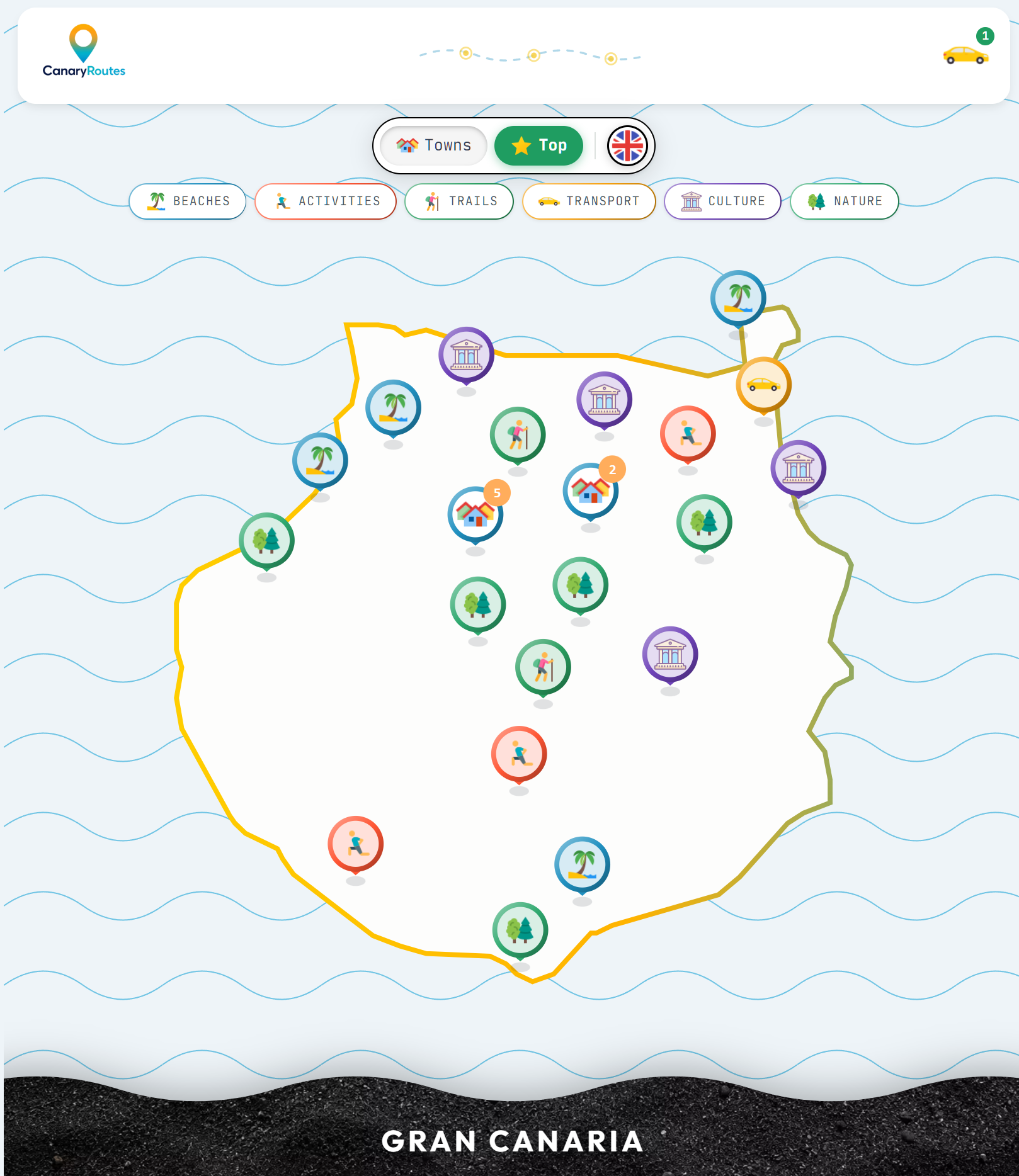
Gran Canaria is a continent in miniature. In just 1,560 km² you'll find Sahara-like dunes, peaks over 1,800 metres high, world-class urban beaches, a cosmopolitan capital with a UNESCO World Heritage historic quarter and archaeological sites that transform our understanding of Atlantic prehistory. This guide covers the 10 unmissable places in Gran Canaria to make the most of your visit, whether you have three days or three weeks.
Gran Canaria's most iconic landscape: a field of fine sand advancing toward the sea at the southern tip of the island, a Special Nature Reserve and one of the most famous beaches in Europe.
The Maspalomas Dunes are the unmistakable symbol of Gran Canaria and one of the most astonishing landscapes in the entire Canary archipelago. This dune system of over 400 hectares, formed by fine biogenic sand (shells and marine organism remains), creates a desert landscape that appears transplanted directly from the Sahara to the Atlantic. The Special Nature Reserve that protects them also includes the ancient Maspalomas lagoon, a coastal wetland of enormous ecological value as a resting point for trans-Saharan migratory birds.
The dunes can be explored on foot all day long, but sunrise and sunset are the most photogenic moments: raking light tints the sand gold and ochre while the shadows of the dune crests create spectacular contrasts. Maspalomas Beach to the west and Playa del Inglés to the east frame this natural space with over three kilometres of sand. Access is free; bring water and sun protection as the dunes accumulate heat and offer no shade.
At the southern edge of the dunes, the Maspalomas Lighthouse (1890) is one of the oldest in the Canaries and marks Gran Canaria's southernmost point. The combination of dunes, lagoon, beach and lighthouse in a compact space makes Maspalomas an absolutely unmissable stop.
💡Practical tips
Sunrise and sunset offer the most dramatic light for photographing the dunes — arrive at least 30 minutes early.
Always bring water and sun protection: the dunes offer no shade and retain heat even in winter.
Stick to the marked paths to protect the dune ecosystem — don't cross fenced-off areas.
Camel rides through the dunes are a popular experience, especially with children.
The volcanic monolith that symbolises Gran Canaria: 80 metres of black basalt at 1,813 metres altitude in the heart of the island, with views stretching to Teide on clear days.
Roque Nublo is to Gran Canaria what Teide is to Tenerife: the island's most recognisable natural monument and its geographical and spiritual centre. This 80-metre-tall black basalt monolith rises above a platform at 1,813 metres altitude, in the heart of the municipality of Tejeda, surrounded by a volcanic caldera landscape of austere, powerful beauty.
For the Guanches, Roque Nublo was a sacred meeting place for the island's menceys (kings). Today it is the centrepiece of one of Gran Canaria's most valuable protected natural spaces: the Nublo Rural Park, a mosaic of pine forests, rocky ridges and ravines harbouring extraordinary biodiversity. The most popular access trail starts from La Goleta (about 3 km round trip, 200 metres of elevation gain), is accessible for moderately fit walkers and requires no special equipment.
From the base of the monolith on clear days you can see Teide rising above the clouds on the western horizon — one of the most impressive views in the whole archipelago. The village of Tejeda, just a few kilometres away, is one of Gran Canaria's prettiest with its traditional white architecture and almond trees in bloom in January and February.
💡Practical tips
The path from La Goleta (access via the GC-600) is the easiest — 45-60 minutes of moderate climbing.
In January and February Tejeda's almond trees are in bloom — combine the Nublo hike with a visit to the village.
Clear winter mornings are the best time to see Teide in the distance.
Wear hiking shoes or footwear with a gripped sole — the path has stretches of loose earth and rock.
Spain's best urban beach and one of Europe's finest: over 3 km of fine sand in the heart of the capital, with a natural reef called La Barra creating sheltered waters all year round.
Playa de Las Canteras has something extraordinary: it is a city beach that competes with the world's best beach destinations. Its 3.2 kilometres of fine yellow sand right in the centre of Las Palmas de Gran Canaria, sheltered from Atlantic swells by La Barra — a natural basalt reef — create a safe, calm swimming environment for virtually the entire year. No other Spanish capital has anything like it.
The Las Canteras promenade is the social axis of Las Palmas: restaurants, bars, surf shops, tapas bars and terraces stretch along the full length of the beach in an atmosphere that mixes tourists and local life in equal measure. The beach huts in the sand, surfing at the northern end (La Cicer), snorkelling at La Barra and beach volleyball games make Las Canteras an active place at any time of day.
To the south of the beach, the La Isleta neighbourhood has an authenticity that contrasts with the rest of the tourist city. To the north, the Alfredo Kraus Auditorium marks the end of the promenade with its striking architecture directly facing the Atlantic.
💡Practical tips
The southern section of Las Canteras (opposite Hotel Santa Catalina) is quieter — the northern end (La Cicer) is preferred by surfers and younger visitors.
La Barra is a snorkelling reef within easy reach: diverse marine life at just two metres depth.
The promenade has excellent restaurants — some of the best are on the perpendicular side streets, slightly back from the beachfront.
Las Canteras is not an EU Blue Flag beach due to its reef waters, but it meets high quality standards — the water is clean and the service is excellent.
Las Palmas' oldest historic quarter: 15th-century colonial streets, the birthplace of Pérez Galdós, the Cathedral of Santa Ana and a cultural scene that makes it one of Spain's finest historic neighbourhoods.
Vegueta is the birthplace of Las Palmas de Gran Canaria and one of the best-preserved historic centres in the Atlantic world. Founded in 1478 by Castilian conquistadors, its grid of cobblestone streets and manor houses with interior courtyards and carved wooden balconies has survived almost intact for over five centuries. Walking along Calle Mayor de Triana, Plaza de Santa Ana or Callejón de Las Piedras is to travel back to the history of how Europe reached America — it was from the Canary Islands that many of the fleets that crossed the Atlantic were supplied.
The centrepiece of Vegueta is Plaza de Santa Ana, presided over by the Cathedral of Santa Ana — begun in 1497 and completed in the 19th century, it is the oldest cathedral in the islands — and the Episcopal Palace. Facing the cathedral, Pánfilo de Narváez's bronze dogs complete the scene. The quarter concentrates first-rate museums: the Museo Canario (with the world's most important Guanche archaeological collection), the Casa-Museo Pérez Galdós (dedicated to the greatest Spanish novelist of the 19th century, born here in 1843) and the Atlantic Centre of Modern Art (CAAM).
💡Practical tips
The Museo Canario is essential for understanding Guanche culture — allow at least two hours.
The Casa-Museo Pérez Galdós is surprisingly intimate and well curated — perfect for literature lovers.
The best contemporary Canarian cuisine restaurants are around Plaza del Pilar Nuevo.
Vegueta is 15 minutes' walk from Las Canteras — combine them in a morning or afternoon for a perfect day in Las Palmas.
The most important archaeological site in the Canary Islands: Guanche geometric cave paintings over 600 years old in an underground necropolis that changed our understanding of Atlantic prehistory.
The Cueva Pintada of Gáldar is one of the most remarkable archaeological sites in all of Europe and the most important in the Canary Islands. Discovered in 1873 during construction work, the cave reveals a complex of artificial caves carved into volcanic tuff that served as habitat and necropolis for Guanche culture between the 7th and 15th centuries. What makes it truly exceptional are the geometric paintings — concentric circles, chessboard patterns, triangles and spirals — executed with natural pigments (red, black, white and yellow) at a quality of execution that has astonished specialists since its discovery.
The museum surrounding it, inaugurated in 2006 after decades of restoration, is itself a notable architectural piece: a large climate-controlled building protects the original site while allowing visitors to observe it from walkways suspended above the excavations. The visit includes an audiovisual introduction to Guanche culture, the tour of the outdoor site (with houses, silos and burial areas) and access to the painted cave itself.
The municipality of Gáldar, in the northwest of the island, is also one of Gran Canaria's most authentic: its weekly market and tapas bars are a destination in their own right.
💡Practical tips
Visits are guided with limited capacity — book online in advance, especially in high season.
The cave maintains a constant temperature of 18-20°C — bring a light layer even if it's hot outside.
Photography without flash is permitted; tripods are not allowed inside the cave.
Combine the visit with Gáldar's Saturday market for an authentically local experience.
A 1 km-wide volcanic crater, 200 metres deep, just 15 minutes from Las Palmas: one of the best examples of recent volcanism in the Canaries, with a 360-degree panoramic viewpoint from Pico de Bandama.
The Bandama Caldera is one of the best examples of recent volcanism you can see in the Canary Islands, and what is most surprising is how close it is to the capital. Just 15 kilometres from central Las Palmas, this phreatomagmatic eruption crater is 1 kilometre wide and 200 metres deep. Inside, an abandoned farmstead and some terraced crops bear witness to the fact that until just a few decades ago the crater floor was inhabited.
The visit can be done in two ways. The first is to look into the crater from Pico de Bandama (569 m), reached by car along a spiral paved road — from the top there is a 360-degree view taking in the crater, the Telde valley, Las Palmas, the north of the island and, on clear days, Tenerife and Teide. The second is to descend into the crater interior along a dirt path (40-50 minutes down, somewhat more back up) that winds through tabaibal and cardonal vegetation to the floor.
Just metres from Pico de Bandama, the Real Club de Golf Las Palmas (founded 1891, Spain's oldest golf club) occupies the volcanic plateau surrounding the crater — a peculiar and photogenic contrast.
💡Practical tips
The road to Pico de Bandama ends at a free car park next to the viewpoint.
The trail to the crater floor is not officially signposted — bring an offline maps app (Komoot or Wikiloc).
The descent takes about 40 minutes; the return climb can be demanding in summer — bring water.
From Pico de Bandama to the Vegueta complex is just 15 minutes by car — easily combined.
Gran Canaria's finest coastal viewpoint: a volcanic stone balcony above the northwest cliffs with views of Tenerife, Teide and the endless Atlantic.
The Mirador del Balcón, on the GC-200 road between Agaete and Puerto de Las Nieves, is undoubtedly the most dramatic coastal viewpoint in Gran Canaria. Positioned 300 metres above sea level, this volcanic stone balcony overlooks one of the island's most rugged coastlines: black cliffs plunging straight into the Atlantic, without beach or break, for kilometres in both directions. On clear days — which is most days — Teide stands sharply on the western horizon.
The viewpoint itself is a simple railing platform with no services or entry fee, accessible directly from a small road-side car park. The experience is one of Gran Canaria's purest: arrive, lean over the void and be left speechless. The afternoon, with raking light illuminating the cliffs and Teide in the background, is the most recommended time.
The GC-200 road leading to the viewpoint is itself one of the most spectacular in the Canary Islands: carved into the living rock of the northwest coast, with tight curves above the sea. Puerto de Las Nieves, 5 km away, is the arrival point of the Tenerife ferry and has excellent fresh fish restaurants.
💡Practical tips
The Mirador del Balcón is free to access — just park in the dedicated lay-by on the GC-200.
Late afternoon (4-7 pm in summer) is the best time for light and to see Teide.
The GC-200 is narrow and winding — drive carefully and give way to lorries.
Puerto de Las Nieves, 5 km away, has the best fresh fish on the northwest coast — easily combined.
Gran Canaria's most famous natural pools: crystal-clear rock pools carved from volcanic basalt at Puerto de Las Nieves, with a backdrop of cliffs and the best view of Teide.
The natural pools at Puerto de Las Nieves, in the municipality of Agaete, are the most visited and spectacular in Gran Canaria. Unlike sandy beaches, these natural basins carved from black volcanic rock offer Atlantic swimming in crystal-clear waters with the wave energy absorbed by the rocky formation itself. The contrast between black rock, turquoise water and blue sky creates a visual palette reminiscent of the pools of Madeira or the Azores.
The pools are integrated into the fabric of Puerto de Las Nieves, Agaete's port and the arrival point of the fast ferry from Tenerife. In low season they are a quiet spot for diving and swimming; in summer they fill with local families who come every weekend. The water is cold even in summer — which for many is an additional appeal in the July and August heat.
The municipality of Agaete, 3 km from the pools, is one of Gran Canaria's most authentic and beautiful. The Valle de Agaete, with its coffee, citrus and cherimoya crops on terraces above the ravine, is a half-hour excursion that perfectly complements a visit to the pools.
💡Practical tips
The pools have public changing rooms and showers — free access, sun lounger and umbrella hire available.
The restaurants beside the pools serve the freshest fish on the island — grouper and sea bream are local specialities.
Combine the pools with the Valle de Agaete (Canarian coffee, chirimoyas) for a full day in the northwest.
In August the pools host the Fiestas del Charco, one of Gran Canaria's most original festivals — check exact dates.
The most innovative aquarium in the Atlantic: a wave-shaped building at Las Palmas port where 35 million litres of water house over 350 marine species in unique oceanic ecosystem recreations.
Poema del Mar, opened in 2017 at the port of Las Palmas de Gran Canaria, is one of the most advanced aquariums in the world and the most modern in the Atlantic. Its building, designed by German architect Peter Chermayeff, is shaped like a wave and houses a collection of marine ecosystems spanning Indo-Pacific coral reefs, deep Atlantic waters, Caribbean mangroves and the unique ecosystems of the Canary Islands.
The centrepiece of the visit is the Great Reef: an 8-million-litre tank with a 35-metre-high acrylic viewing panel — the tallest in Europe — through which you can watch bull sharks, rays, turtles and hundreds of tropical species in motion. The jellyfish hall, with its shifting coloured lighting, is another of the visit's most hypnotic moments. The entire aquarium is designed around a conservation philosophy: its own researchers participate in endangered species preservation projects.
Poema del Mar is the perfect counterpart to Loro Parque in Tenerife for travellers with children or marine biology enthusiasts.
💡Practical tips
Buy tickets online to skip queues — in peak season they can be long at the ticket office.
Plan your visit around the shark feeding times — these are the most spectacular moments.
The aquarium is at Las Palmas port, very close to Vegueta — combine them in the same afternoon.
The aquarium shop stocks quality marine conservation-themed items — perfect as souvenirs.
Gran Canaria's most accessible laurel forest: a green, humid ravine in the north of the island where centuries-old Canarian bay trees create a miniature natural cathedral.
The Los Tilos de Moya forest, in the northern municipality of Moya, is one of Gran Canaria's most surprising corners for those seeking authentic nature away from tourist crowds. This small but dense laurel forest — the oldest surviving ecosystem from what was once the European Tertiary forest — occupies the humid floor of the Moya ravine, where the north-facing trade wind creates a permanently green and cool microclimate.
The star species is the Canarian bay laurel (Apollonias barbujana), an evergreen tree up to 20 metres tall that gives the forest its name. Alongside it grow laurel, holly, heather and viñátigo, in a blend reminiscent of La Gomera's or Anaga's laurel forests though on a smaller scale. The main path crosses the forest in a walk of just 45 minutes round trip, with no significant elevation, suitable for all visitors.
Los Tilos de Moya is the perfect counterpoint to the mass tourism of the island's south: a serene, little-visited spot on weekdays, with a quiet but extraordinarily rich biodiversity — some of Gran Canaria's endemic birds (blue chaffinch, laurel pigeon) find refuge here.
💡Practical tips
The trail is signposted from the ravine car park — easy to follow without a guide.
Visit on a weekday to enjoy the forest in solitude — weekends can see local groups.
The forest's humidity makes the path potentially slippery — wear non-slip footwear.
Combine the visit with the village of Moya and its colonial church for a complete half-day in the north.
How many days do you need to see the best of Gran Canaria?How many days do you need to see the best of Gran Canaria?
With 5-7 days you can comfortably cover Gran Canaria's highlights: one day in the south (Maspalomas + Playa del Inglés), one day in Las Palmas (Las Canteras + Vegueta + Poema del Mar), half a day at Roque Nublo and Tejeda, half a day in Agaete (pools + Mirador del Balcón), and the rest for Cueva Pintada, Los Tilos de Moya and Bandama Caldera. With 3-4 days, focus on Maspalomas, Roque Nublo, Las Canteras and Vegueta.
What is the best time of year to visit Gran Canaria?What is the best time of year to visit Gran Canaria?
Gran Canaria has exceptional weather all year round. The south (Maspalomas, Playa del Inglés) is the driest and sunniest zone — great even in winter. The north and interior (Tejeda, Moya, Agaete) are more variable with mist and rain in winter. May to October are the warmest months for beaches. In January-February Tejeda's almond trees are in bloom — one of the Canaries' most beautiful spectacles.
Do you need a car to visit Gran Canaria?Do you need a car to visit Gran Canaria?
For maximum freedom a car is highly recommended, especially for the interior (Roque Nublo, Tejeda), the northwest (Agaete, Mirador del Balcón, Los Tilos) and Cueva Pintada. Las Palmas has excellent public transport and you don't need a car there. Car hire is affordable and can be picked up at Las Palmas Airport (LPA).
What to see in Gran Canaria with children?What to see in Gran Canaria with children?
The best options for families with children in Gran Canaria are: Poema del Mar (spectacular aquarium), the Maspalomas Dunes (camel rides and dune walks), Agaete natural pools (volcanic rock swimming), Aqualand Maspalomas (water park) and the Roque Nublo hike (easy trail with rewarding views). Las Canteras beach is ideal for families thanks to its calm waters.
How to get to Gran Canaria from Tenerife?How to get to Gran Canaria from Tenerife?
There are two options: the fast ferry (FastFerry or Fred. Olsen) covering the Agaete-Santa Cruz de Tenerife route in approximately 80 minutes, or the flight between airports (25-30 minutes). The ferry is more affordable and arrives at the northwest of Gran Canaria (Puerto de Las Nieves, near Agaete) — ideal if you plan to visit the natural pools or Mirador del Balcón on arrival.