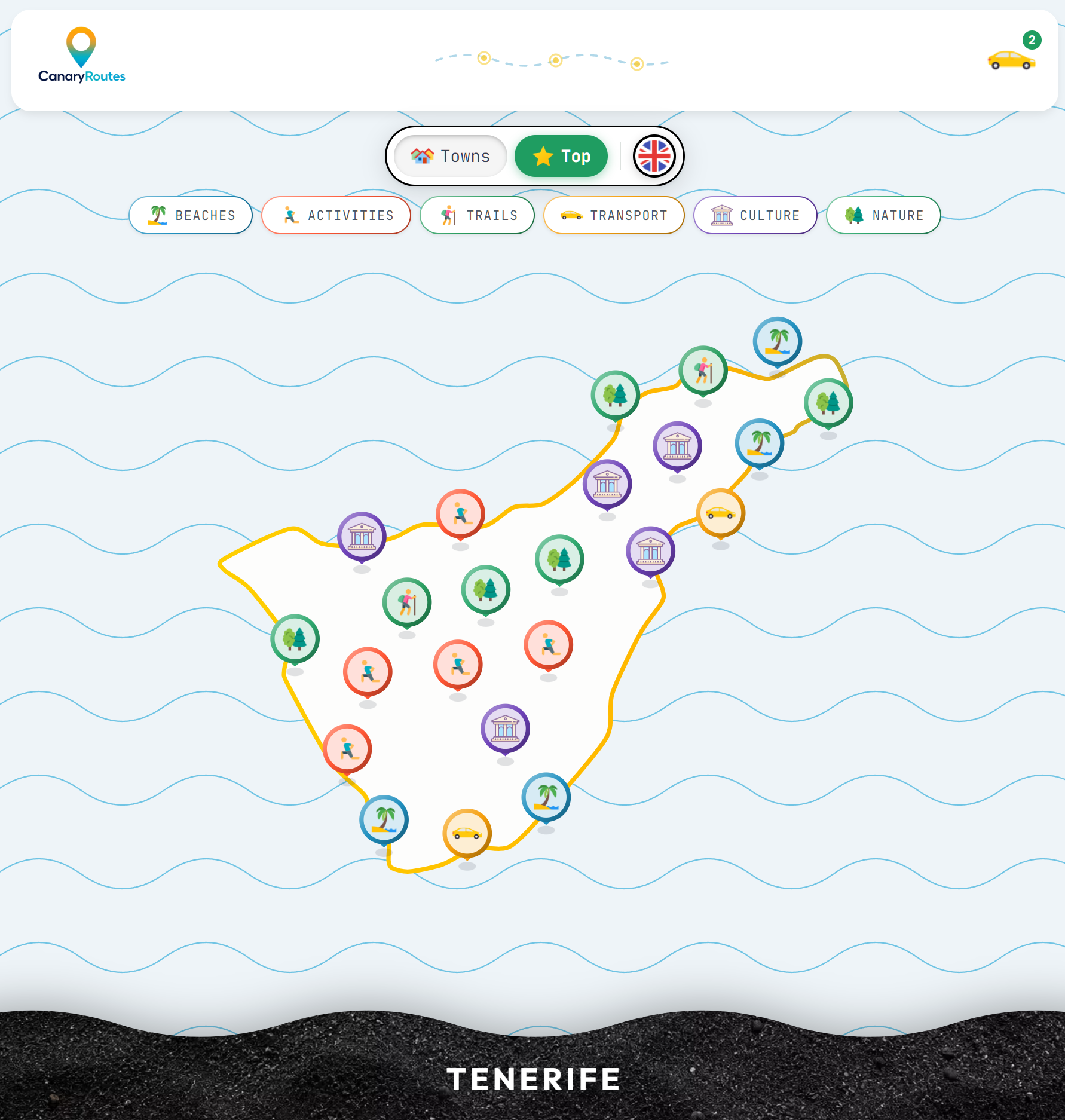
Tenerife is far more than sun and sand. The largest of the Canary Islands hides an active volcano that is the highest point in Spain, ancient laurel forests declared a UNESCO Biosphere Reserve, cities on the UNESCO World Heritage list, sheer cliffs plunging into the Atlantic and a leisure scene that keeps it at the top of European destinations all year round. This guide covers the 10 unmissable places in Tenerife so you don't miss anything that makes this island so extraordinary.
The volcanic heart of Tenerife: Spain's highest volcano and one of the most visited in the world, surrounded by a lunar landscape listed as a UNESCO World Heritage Site.
Teide National Park is unquestionably the most iconic place in Tenerife and one of the most visited national parks on the planet. Mount Teide, at 3,715 metres, is the highest point in Spain and the world's third-largest volcanic structure measured from its oceanic base. The landscape surrounding the volcano — Las Cañadas del Teide — is so singular that UNESCO declared it a World Heritage Site in 2007.
The main access is via the TF-21 road from La Orotava or from the south. The cable car climbs to 3,555 metres in eight minutes and on clear days the views stretch to four other islands. Reaching the actual summit crater (3,715 m) requires a free permit that must be booked in advance at the National Park's website — during peak season these fill up weeks ahead.
Beyond the main volcano, the park offers hiking trails for all abilities: from the flat walk around the Roques de García (30 minutes, minimal elevation) to the full ascent from Montaña Blanca (17 km round trip, 1,344 metres of elevation gain). The best time to visit is May to October, though the park is spectacular year-round — in winter there can be snow.
💡Practical tips
Book the crater summit permit at least 2-3 weeks in advance in high season at reservasparquesnacionales.es
The cable car closes in strong wind — check the website before making the journey up.
Bring warm layers even if it's hot below: at the cable car's top station it can be 15°C colder.
The Roques de García at sunset is one of the best photo opportunities in the Canaries — arrive at least an hour early.
Vertical walls up to 600 metres high dropping straight into the Atlantic: one of the most dramatic landscapes in the Canaries and a permanent home to whales and dolphins.
The Los Gigantes Cliffs are one of those landscapes that simply take your breath away. These dark basalt walls rise vertically between 300 and 600 metres above sea level along almost 8 kilometres of coastline in the southwest of Tenerife. Seeing them from land is impressive; seeing them from the sea, aboard a catamaran or speedboat, is a completely different and unmissable experience.
The waters off Los Gigantes are permanent habitat for short-finned pilot whales and the regular scene of sightings of bottlenose dolphins, striped dolphins and sperm whales. The whale-watching excursions that depart from Los Gigantes harbour have one of the highest success rates in Spain. The village of Los Gigantes, though touristy, remains peaceful and has good seafood restaurants with direct views of the cliffs.
💡Practical tips
The best way to see the cliffs is from the sea — boat excursions depart several times daily from Los Gigantes harbour.
The Archipenque viewpoint offers the best land-based view of the cliffs, 10 minutes' walk from the harbour.
Combine a whale-watching excursion with a cliffs sighting — most boats cover both.
Harbour parking is free but limited — arrive before 9:00 am in summer.
The first planned city of the Americas, a UNESCO World Heritage Site: colonial streets, the best food scene on the island and a unique cultural life.
La Laguna is the historical and intellectual soul of Tenerife. Founded in 1496 as the island's first capital, its urban layout served as a model for many cities across the American continent, earning it UNESCO World Heritage status in 1999. The historic centre preserves an extraordinary collection of Canarian colonial architecture: 16th-century churches, manor houses with interior courtyards and carved wooden balconies that define the Canarian style.
But La Laguna is far more than an open-air museum. It is a lively university city with the highest concentration of bars, restaurants and nightlife in Tenerife. The Calle Noria area and the Camello zone offer a food scene that many consider the best on the island, with restaurants fusing traditional Canarian cooking with contemporary techniques. From the North Airport and from Santa Cruz, the tram connects it in minutes.
💡Practical tips
Visit the interior of La Laguna Cathedral to see the stunning main altar retablo — entry is free.
La Laguna's municipal market (Monday to Saturday) has the best fresh cheese and mojo on the island.
Calle San Agustín has the most photographed colonial houses — visit midweek to avoid crowds.
The tram from Santa Cruz takes 34 minutes — far more convenient than driving.
Tenerife's green lung: a UNESCO Biosphere Reserve with 40-million-year-old laurel forests, breathtaking viewpoints and villages that seem frozen in time.
The Anaga Massif, at the northeastern tip of Tenerife, is one of the oldest and best-preserved ecosystems on the planet. Its laurel forests — relics of the Tertiary period that once covered much of Europe 40 million years ago — form a green sea extending between rocky ridges and deep ravines. UNESCO declared it a Biosphere Reserve in 2015, recognising its exceptional biodiversity: more than 40 endemic plant species that exist nowhere else on Earth.
What makes Anaga special beyond its nature is the feeling of stepping back in time. Small villages like Chamorga, Afur and Chinamada cling to the hillsides as if time stopped decades ago. The viewpoints at Cruz del Carmen, Pico del Inglés and Las Carboneras offer panoramas spanning northern Tenerife, the Atlantic and, on clear days, Gran Canaria in the distance. It is the perfect counterpoint to the tourist Tenerife of the south.
💡Practical tips
The Cruz del Carmen Visitors' Centre (km 13 of the TF-12 road) is the best starting point for trails and maps.
The Anaga road is narrow and winding — drive slowly and use the designated passing places.
Always bring a warm layer and waterproof: the forest can be shrouded in mist and drizzle even in summer.
For longer trails like Chamorga or Afur-Tamadite, start before 9:00 am to avoid groups.
Repeatedly voted the world's best water park: two-metre waves, extreme rides and a stunning Thai temple setting that makes it a one-of-a-kind experience.
Siam Park is not just any water park. Voted the world's best water park by TripAdvisor for seven consecutive years, Costa Adeje's flagship attraction offers an experience unmatched anywhere in Europe. The Dragon, the headline ride, is one of the fastest slides on the planet: a 28-metre vertical drop in just five seconds. The Giant Wave generates artificial waves up to two metres high, perfect for surfing. The Lazy River winds through the whole park in a circuit of over 600 metres.
What sets Siam Park apart is the quality of its execution: the Thai temple décor is genuinely impressive, the maintenance standards are impeccable and the variety of attractions covers everyone from toddlers to thrill-seekers. It's a must-visit for families with children, but equally worthwhile for adults looking for a premium day of fun in an extraordinary setting.
💡Practical tips
Buy tickets online in advance to skip queues and save up to 15%.
The most popular rides (Dragon, Tower of Power) have queues from opening — go straight to them when the park opens.
Entry includes access to Siam Beach, a private beach with loungers and hammocks.
Bring water-resistant sunscreen — queues in the sun can last 20 to 40 minutes in peak season.
Tenerife's most famous northern beach: golden Saharan sand, sheltered waters and the authentic fishing village of San Andrés just behind it.
Playa de Las Teresitas breaks every expectation you might have of a northern Tenerife beach. Just 7 km from Santa Cruz, in the San Andrés district, more than a kilometre of golden sand — shipped from the Western Sahara in the 1970s — contrasts with the dark green mountains of Anaga rising behind it. An offshore breakwater shelters the bay from Atlantic swells, creating calm waters perfect for family swimming.
The atmosphere at Las Teresitas is genuinely local: Tinerfeños fill the beach at weekends and San Andrés' restaurants serve the most honest fresh fish on the island. There are no beachfront hotels, no loud beach bars — just the beach, the village and the horizon. This is the Tenerife that tour operators don't put in their brochures.
💡Practical tips
The restaurants in San Andrés (200 m from the beach) offer the island's best fresh fish at fair prices.
Bus 910 from Santa Cruz takes 20 minutes — far more convenient than driving in summer.
North of Las Teresitas is Playa de Las Gaviotas, without artificial sand or services — for those who prefer solitude.
Arrive before 10:00 am at summer weekends if you want to choose your spot comfortably.
The oldest tree in the Canary Islands: a dragon tree over a thousand years old that is the official symbol of the Canaries and a living link to Guanche history.
The Millenary Dragon Tree of Icod de los Vinos is one of those trees that makes you reflect on the scale of time. Estimated to be between 800 and 1,000 years old (dragon trees don't form annual rings, making exact dating difficult), it is the oldest and largest known specimen of Dracaena draco: 17 metres tall, a crown spanning 20 metres and a trunk almost 10 metres in circumference.
This tree, the official symbol on the Canary Islands flag, was sacred to the Guanches — Tenerife's pre-European inhabitants — who used it for medicinal and ritual purposes. The dragon tree's resin, a dark red substance known as dragon's blood, has antimicrobial and healing properties. The dragon tree can be seen from the viewpoint of San Marcos Church in Icod (free) or you can enter the Dragon Tree Park that surrounds it for a modest fee.
💡Practical tips
The view from the San Marcos Church viewpoint is free — if you don't want to pay park entry, it's perfectly sufficient.
Combine the visit with Icod de los Vinos' historic centre and a Malvasía wine tasting — the town has wineries with tastings.
Best photos are in the early morning, with side light and no tour groups.
15 minutes' drive away is El Caletón in Garachico — perfect to combine in a northwest island loop.
The strait between Tenerife and La Gomera is a permanent home for pilot whales and a regular sighting ground for dolphins and whales throughout the year.
The stretch of water separating Tenerife from La Gomera is one of the few places in the world where cetaceans can be seen year-round. Short-finned pilot whales (Globicephala macrorhynchus) live here permanently in groups of 20 to 200 individuals. Bottlenose dolphins appear almost daily, and with some luck you can spot sperm whales, orcas, striped dolphins and even fin whales.
Excursions depart mainly from Los Gigantes, Los Cristianos and Puerto Colón harbours. Boats equipped with hydrophones allow passengers to listen to the cetaceans' underwater communications, adding a scientific dimension to the experience. Spanish cetacean-watching regulations prohibit approaching closer than 60 metres or cutting across the animals' path, so it's worth choosing certified operators that follow the code of conduct.
💡Practical tips
Book ahead in peak season (June-September) — excursions sell out days in advance.
Morning departures have better visibility and calmer seas — always choose the morning slot if you can.
Bring a warm layer even in summer — sea temperatures are significantly lower than on land.
If you're prone to seasickness, take preventive medication at least 30 minutes before boarding.
The most important shrine in the Canary Islands: patroness of the archipelago, a centuries-old pilgrimage site and a unique meeting point of Guanche tradition and Catholicism.
The Basilica of Our Lady of Candelaria, in the coastal town of the same name, is the most important place of worship in the Canary Islands and one of the major pilgrimage destinations in the Atlantic world. The Virgin of Candelaria, patron saint of the Canaries, was reportedly found miraculously by the Guanches before the Spanish conquest — according to tradition, in the late 14th century — making this shrine a unique place of syncretism between Guanche spirituality and Catholicism.
The square in front of the basilica is presided over by nine bronze statues of the Guanche menceys — the kings of the nine kingdoms into which the island was divided before the conquest. It is a condensed moment of history in stone and metal that invites reflection. On 14 and 15 August, thousands of pilgrims arrive from across the Canaries and Latin America for a celebration of enormous anthropological value.
💡Practical tips
The basilica and square are freely accessible all year round.
On 14 and 15 August crowds are at their peak — the night of the 14th has a special atmosphere if you want to experience it more peacefully.
Candelaria town has good Canarian restaurants at more reasonable prices than the tourist south.
Parking near the centre can be difficult — there is free parking 10 minutes' walk away at the coastal recreational area.
One of the best zoological parks in Europe: orcas, beluga whales, penguins, gorillas and the world's largest parrot collection in Puerto de la Cruz.
Loro Parque has evolved from its founding in 1972 as a parrot collection into one of the best zoological and conservation parks in Europe. Located in Puerto de la Cruz in northern Tenerife, it houses an exceptional animal collection: the world's largest parrot and psittacine collection (over 4,000 specimens), Europe's largest shark aquarium, the largest penguin colony outside Antarctica and a group of western lowland gorillas raised in a meticulously recreated tropical forest environment.
The Loro Parque Foundation runs conservation projects in 45 countries and has prevented the extinction of several parrot species. The orca and beluga shows are controversial for some visitors — the park argues these are captive-born animals that could not survive in the wild — but the level of animal welfare and the educational quality of the shows are undeniable. It is a complete experience that blends entertainment, conservation and environmental education.
💡Practical tips
Buy tickets online at least a week in advance to avoid queues and get the best price.
The orca and dolphin shows have fixed schedules — plan your visit around them so you don't miss any.
The park is in Puerto de la Cruz, 40 minutes from the south by car — a good plan is to combine a morning at Loro Parque with an afternoon exploring the town.
With children, allow at least 6-7 hours to see everything comfortably.
How many days do you need to see the best of Tenerife?How many days do you need to see the best of Tenerife?
5-7 days gives you enough time to cover Tenerife's highlights: one day on Teide, one day in Anaga, one or two days in the north (La Laguna, Icod, Garachico), half a day at Los Gigantes and the remaining days for the southern beaches and leisure. With less time (3-4 days), focus on Teide, La Laguna and the southern beaches, which are the most accessible experiences.
What is the best time of year to visit Tenerife?What is the best time of year to visit Tenerife?
Tenerife has exceptional weather all year round, with coastal temperatures between 20 and 28°C. May to October are the driest and warmest months, ideal for beaches and outdoor activities. November to April the weather is more variable but still mild — perfect for hiking in Anaga or cultural visits. February brings the Santa Cruz Carnival, one of the largest in the world.
Do you need a car to visit Tenerife?Do you need a car to visit Tenerife?
A car gives you full freedom, especially for visiting Anaga, Teide, Los Gigantes and Icod. For the southern tourist areas (Las Américas, Los Cristianos, Costa Adeje) and the Santa Cruz-La Laguna corridor, public transport (tram + buses) works very well. Car hire is affordable and can be picked up at both airports. For a week's stay, we recommend having a car for at least 3-4 days.
What to see in Tenerife with children?What to see in Tenerife with children?
Children's favourites in Tenerife are Siam Park (world's best water park), Loro Parque (orcas, penguins, gorillas), the whale- and dolphin-watching boat trip from Los Gigantes, the natural pools at Garachico and, for older children, the cable car ride up Teide. The southern beaches (Las Teresitas, Los Cristianos, Las Vistas) are ideal for young children due to their calm waters.
When is the best time to visit Teide National Park?When is the best time to visit Teide National Park?
Teide is spectacular all year. In summer (June-September) the weather is most stable and the roads are always clear. In winter there can be snow and conditions change rapidly. For the hike from Montaña Blanca, May to October are the safest months. Book the crater summit permit weeks ahead — spaces are limited and fill up fast.